Join me at The Necessary magazine

I’ve put the powdered wig in mothballs, traded the quill and ink for multimedia editing software, and immigrated to the 21st century. If you have even the slightest interest in music, fiction, poetry, painting, sculpture, dance, theater, film, or any other form of art, you should come to The Necessary, an arts magazine like no other. Once there, be sure to click the Follow button. See you in the present.

Wherefore the long silence?

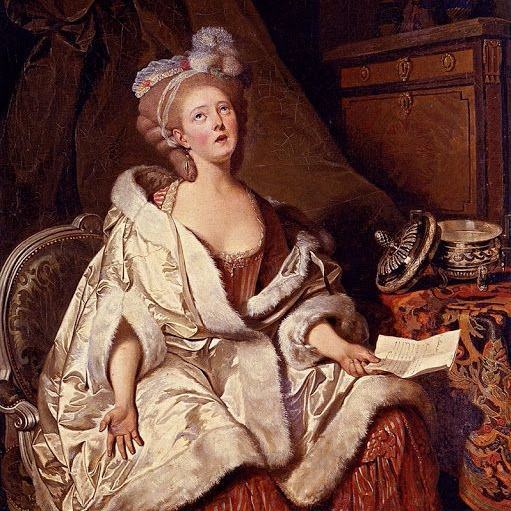
Woman Reading a Letter, 1775 by Pierre-Alexandre Wille

If you allow a blog to go dark, as I’ve done over the past year and a bit, people tend to assume the worst. My wife, Kathleen, has been flooded with expressions of sympathy: “Can I have his old Volvo?” “Did he leave anything in a size 38?” “Would he have minded if I asked you out?”

Imagine the puzzled look on people’s faces when she replies, “You’d better ask him. He’s standing right here!”

Yes, my friend, I am very much alive, and so is my book project. Sure, there are days when I think the book will kill me, but that’s probably true of any author who has to climb very tall trees to acquire the eagle quills he or she is using to write the manuscript.

Why did I stop posting? Because, much as I enjoy our time together, I discovered that I can either write a blog or write a book. If you haven’t heard from me in a while, that’s a good thing — it means the book is coming along. And when I do post, like today? Well, you should probably just pat me on the fanny and offer a few words of encouragement, such as “You get back in your cage RIGHT NOW, BUSTER! And don’t come out until you’ve produced a towering, swash-buckling thrill of a book whose fully realized characters leap off the page!”

But as long as I’m off my leash for a second, let me give you a quick update.

The project has morphed quite a bit. For one thing, it’s no longer a story collection. I set out to write short stories for the simple reason that I didn’t feel ready to write a novel. Then I got wise to the fact that you never feel ready to write a novel — any more than you feel ready to drink a big bottle of Pine-Sol. If you’re going to do it, you just have to do it. And so my story collection has become a novel (a comic novel, because of the kind of guy I am). The working title remains His Effing Nibs.

I’m sorry to say I had to fire my two main characters. Lord Timothy Dexter and Jonathan Plummer, real-life eighteenth-century figures who fascinated me, were too obscure to justify the amount of control they insisted on having over the plot. I replaced them with fictional characters who do as I tell them. And here is how their story is unfolding:

In a New England seaport in 1789, Samuel Poore, an itinerant wordsmith, applies for the job of Poet Laureate to the principled but unpopular Lord Benjamin Barley (aka His Effing Nibs). Samuel, much degraded by his years as an indentured servant, hopes the fancy title will launch him into polite society. But the job is not what it seems. His real assignment, he learns, is to teach reading and writing to runaway slaves — dozens of whom have found sanctuary on Barley’s estate. Samuel is torn between his longing for respectability and his students’ (and his employer’s) quest for justice. The resolution comes only after an abduction, a rescue attempt, and a guest appearance by a celebrity slaveholder.

I include, at no extra charge, subplots concerning animal rights, a tug-o-war over the future of America’s enslaved population, and the writing of a sex manual called The Pleasures of the Marital Bed by an author who is entirely lacking in firsthand knowledge.

Now well into the first draft, I’m glad I chose the novel over the short stories, and really glad I held off on the Pine-Sol. Thanks for checking in. The next time you hear from me, I just might have something to show you.

Battle of quills

Tags

, ,

My friend John Taylor, of Washington, D.C., recently asked if I wanted to pit my bald eagle against one of his two Congo African gray parrots. In terms of air superiority, there would of course be no contest. But John had in mind a different sort of competition, a battle of letters. Whose feathers make the better quill pens, he wondered — America’s mighty national bird or his pampered equatorial brainiac? On behalf of the local nesting eagles who supply the bulk of my writing instruments, I accepted the challenge.

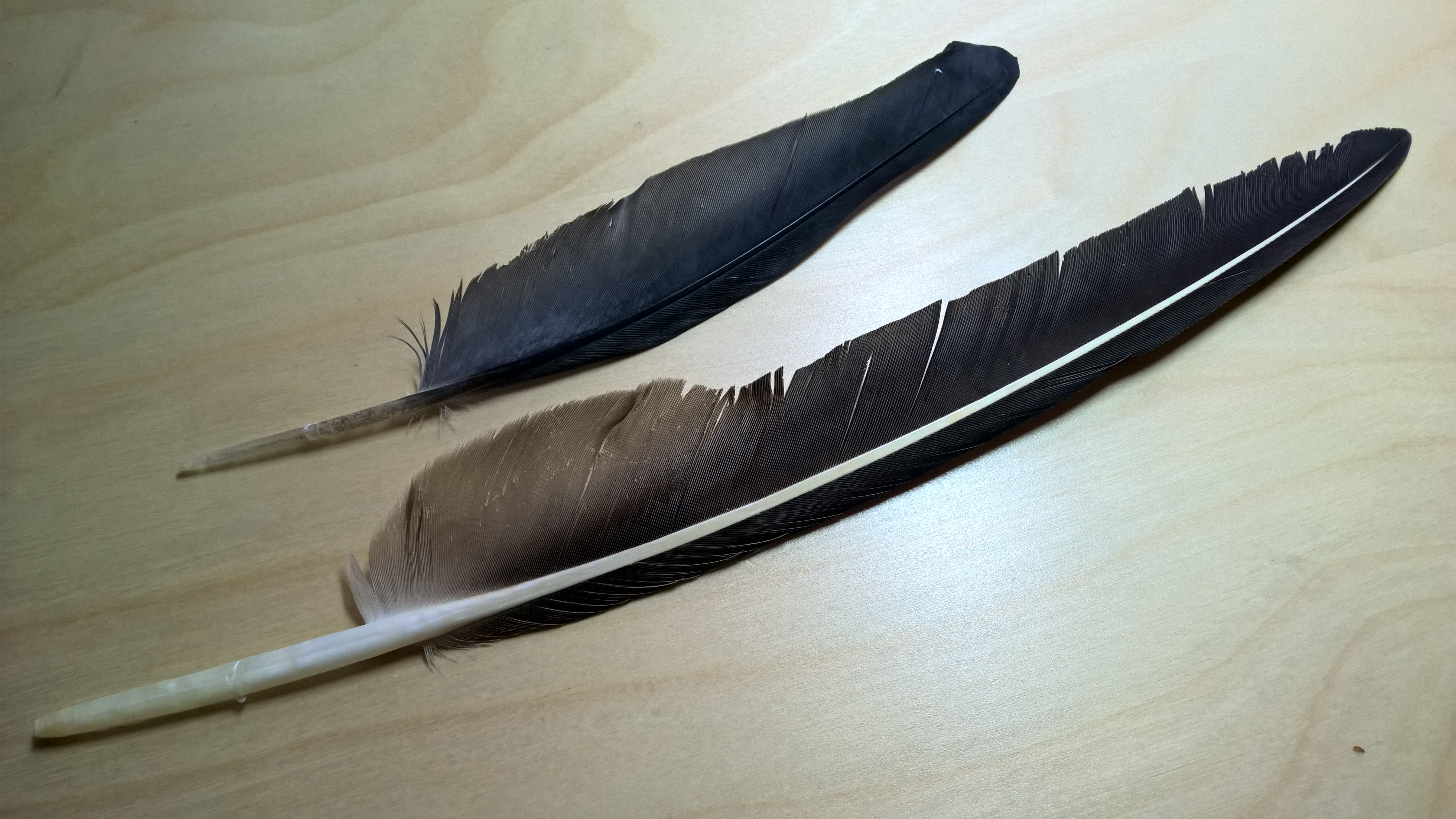
John sent me a few flight feathers retired by his parrot Chimo. I selected one at random and put it up against a fresh bald-eagle feather.

Feather of a Congo African gray parrot (top), with superior American feather

Feather of a Congo African gray parrot (top), with superior American bald eagle feather

To ensure a level playing field, I gave both quills identical nibs, carved according to the same half-remembered YouTube video. Both quills would copy the same line of text, the opening of Lord Timothy Dexter’s little book, A Pickle for the Knowing Ones (spelling courtesy of Lord Dexter). And both would employ the same media: Pelikan 4001 Fountain Pen Ink in violet — my go-to ink for purple prose — on Staples 110-pound card stock.

By a coin toss, the American bald eagle went first.

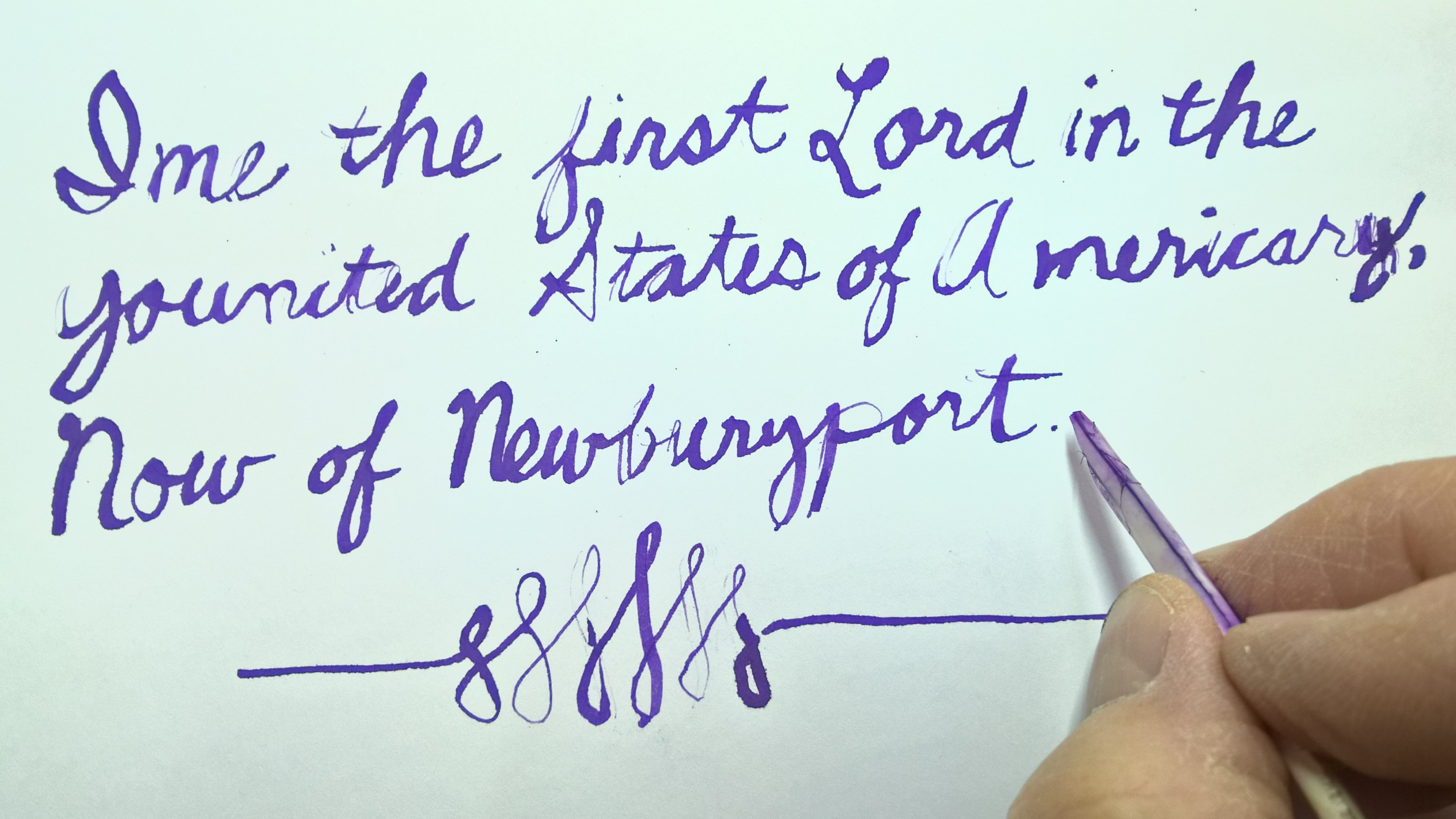
Quill of the American bald eagle

Quill of the American bald eagle

As the above image makes clear, the eagle delivered exactly the type of performance you’d want to see from the avian symbol of the United States: confident, slightly illiterate, and prone to guzzle ink by the gallon. Nice swagger, USA! Now let’s see if the chattering challenger can top that.

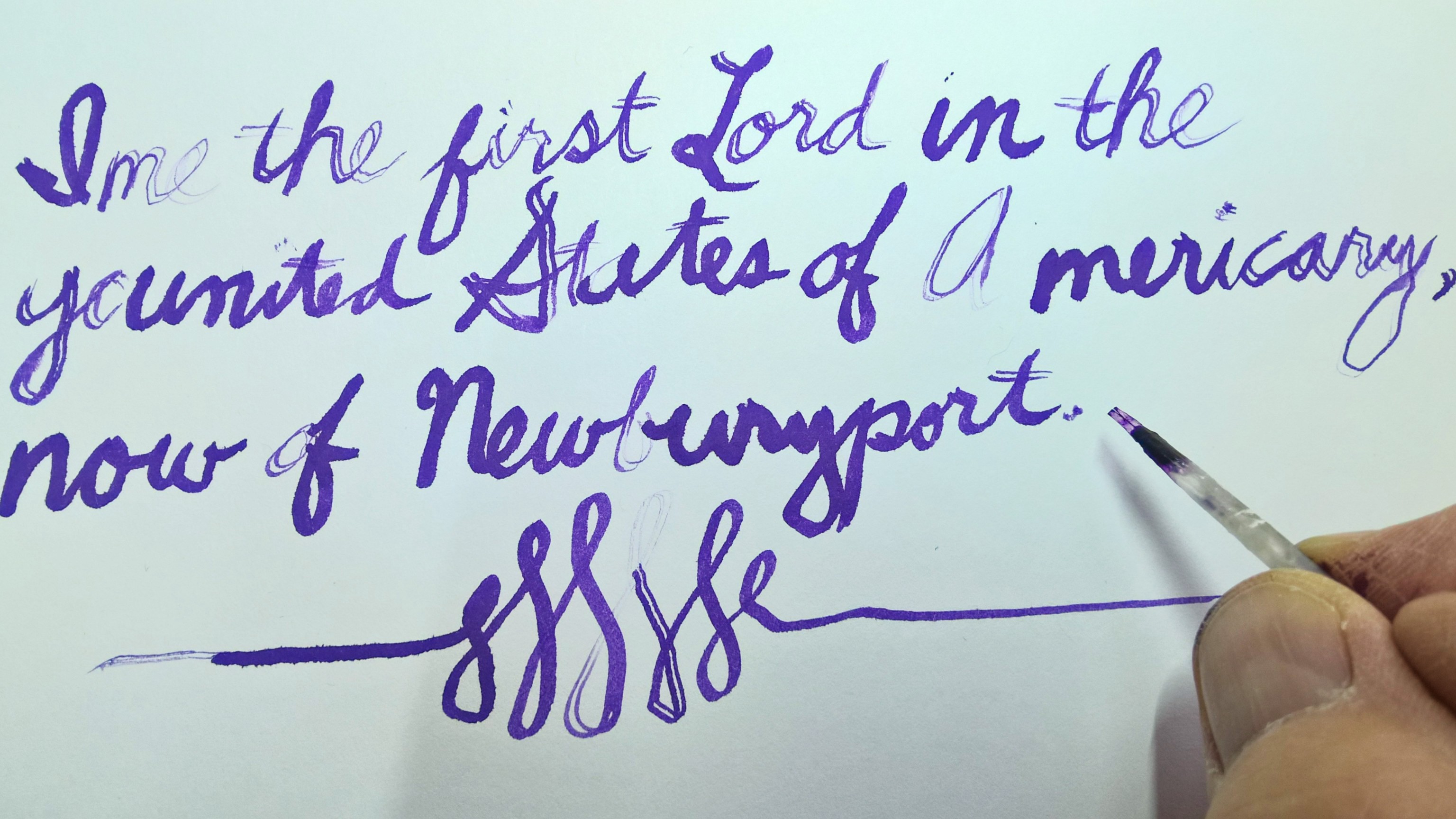
Quill of the Congo African gray parrot

Quill of the Congo African gray parrot

Aw, too bad. Those initials are bold enough, but everything else looks kind of wispy and intellectual. There’s no follow-through, as though Chimo’s heart just wasn’t in it.

In fairness to Congo African grays, it’s possible that John’s parrot did not volunteer his best plumage. Birds seldom do. In my dealings with American bald eagles, I always show the bird who’s boss. I see the quill I want (which, as I’ve noted before, is the second or third primary flight feather of the left wing), and I take it. Twist, tug, and gone. Usually, of course, I dangle a squirrel in front of the bird to distract it. I imagine an African gray would be similarly mesmerized by, oh, a little savory cracker and a morsel of soft cheese, or The News Hour with Jim Lehrer. We’ll have a rematch as soon as Chimo grows a pair.

Meanwhile, I’ll put my American eagle up against your Alpine swift, your Siberian crane, your Nubian bustard, whatever type of exotic feather you care to throw my way. But be forewarned: unless I completely misread the literary market, Americans want to buy books written with the quills of American birds. And that’s the only kind of quill I use.

Minstrel of the Merrimack

Tags

, , , ,

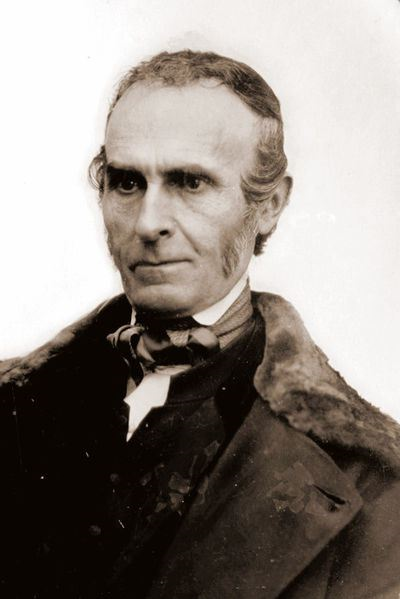
In my previous post, I proved beyond a doubt that Jonathan Plummer (1761 – 1819), the real-life jack-of-all trades who narrates my stories, was a classic nerd. But that didn’t prevent him from leaving a mark on his corner of New England. In an essay called “Yankee Gypsies,” the poet John Greenleaf Whittier (1807 – 1892) remembers the “nimbus of immortality” that accompanied Plummer’s visits to Whittier’s boyhood hometown of Haverhill, Massachusetts. For extra credit, see if you can identify the line he stole from the poet Henry S. Ellenwood, quoted in the last post.*

John Greenleaf Whittier

The poet Whittier

Twice a year, usually in the spring and autumn, we were honored with a call from Jonathan Plummer, maker of verses, peddler and poet, physician and parson,—a Yankee troubadour,—first and last minstrel of the valley of the Merrimac, encircled, to my wondering young eyes, with the very nimbus of immortality. He brought with him pins, needles, tape, and cotton-thread for my mother; jack-knives, razors, and soap for my father; and verses of his own composing, coarsely printed and illustrated with rude wood-cuts, for the delectation of the younger branches of the family. No lovesick youth could drown himself, no deserted maiden bewail the moon, no rogue mount the gallows, without fitting memorial in Plummer’s verses. Earthquakes, fires, fevers, and shipwrecks he regarded as personal favors from Providence, furnishing the raw material of song and ballad. Welcome to us in our country seclusion as Autolycus to the clown in Winter’s Tale, we listened with infinite satisfaction to his readings of his own verses, or to his ready improvisation upon some domestic incident or topic suggested by his auditors. When once fairly over the difficulties at the outset of a new subject, his rhymes flowed freely, “as if he had eaten ballads and all men’s ears grew to his tunes.” His productions answered, as nearly as I can remember, to Shakespeare’s description of a proper ballad,—”doleful matter merrily set down, or a very pleasant theme sung lamentably.” He was scrupulously conscientious, devout, inclined to theological disquisitions, and withal mighty in Scripture. He was thoroughly independent; flattered nobody, cared for nobody, trusted nobody. When invited to sit down at our dinner-table, he invariably took the precaution to place his basket of valuables between his legs for safe keeping. “Never mind thy basket, Jonathan,” said my father; “we sha’n’t steal thy verses.”—”I’m not sure of that,” returned the suspicious guest. “It is written, ‘Trust ye not in any brother.'”

* Give up? The purloined passage is “independent; flattered nobody, cared for nobody.”

Did they have nerds in the olden days?

Tags

, , , ,

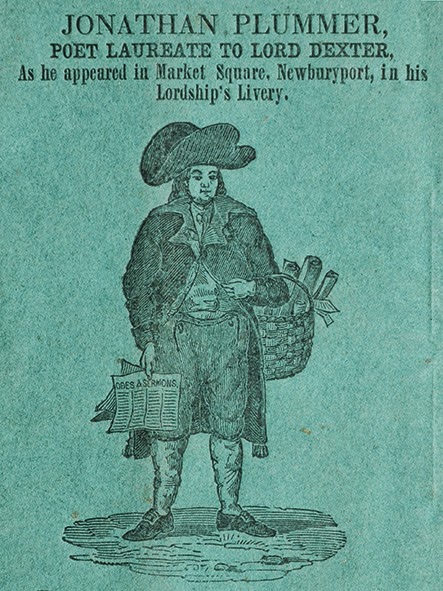
Plummer engravingI am not now, nor have I ever been, a nerd. And yet (you will be surprised to learn) there have been periods in my life when I occasionally exhibited traits that might be described as nerdlike. If you didn’t know me better, the degree in classical accordion and the tweed jacket with elbow patches that I wore every day for a year in my early twenties might have aroused your suspicion. A few people vividly recollect, from my college days, a lush polyester shirt printed with Pre-Raphaelite visions of little girls playing on a beach. (I still say there’s a difference between being a nerd and martyring oneself to art.) Some may remember my seventh-grade parlor trick of reciting pi to forty places, a skill that didn’t impress girls half as much as I thought it would. Throw in a few other peculiarities of my youth — the sci-fi-only reading habits, the mismatched socks, the chilly evenings spent stargazing with my Sears & Roebuck refractor telescope, my mysterious availability for practicing accordion duets on Friday nights — and a pretty damning picture emerges.

But that’s all behind me now. Anyone who walks past my window today and observes the writer at work, clad in perfectly clean underpants and a neat powdered wig, fashioning pen nibs from eagle feathers and sampling his extensive snuff collection while reciting dialog in made-up accents — all in the service of a very promising work of fiction about misfits in the 18th century — can see at once that I am a model of industry and respectability. The point I wish to emphasize is that I am definitely not a nerd.

Perhaps because I am so vigilant about guarding against nerdish tendencies in myself, I am quick to spot such traits in others. Even at a distance of more than two centuries, a grim recognition is setting in as I get to know Jonathan Plummer (1761 – 1819). Plummer is the real-life traveling preacher, teacher, healer, peddler, poet, and pamphleteer I’ve cast as the narrator of my stories. Although the term nerd didn’t exist in his time, the personality type certainly did. A nerd, according to my melding of dictionary definitions and personal observation, follows passions and interests that lie outside the mainstream, yearns for intellectual stimulation, pays little attention to what’s fashionable, tends to be socially clueless, may be ungainly and unathletic, and (thanks to the above qualities) is often isolated or ostracized. Jonathan Plummer was all that and more.

Much of what is known about Plummer’s life comes from the eloquent and revealing memoir he published in his mid-thirties. Sketch of the History of the Life and Adventures of Jonathan Plummer, jun. (Written by himself) survives incomplete. Most of his childhood is missing. But he does tell us that as an adolescent growing up in Newbury, Massachusetts, he was bookish and awkward, obsessed with girls but “diffident to an alarming degree” in their company.

‘Vindictive vengeance’

At seventeen, he refused his father’s offer of a hundred acres to farm. He went to work instead as a book peddler for a Boston publisher. This occupation did not make him any more popular, and not just because it was considered slumming. “My reading, traveling, and thirst for knowledge, too,” he wrote, “began to operate to my disadvantage . . . to make me what they called an odd fellow — that is, different from the young fellows who were not readers.” Had he not been a complete nerd, he would have tailored his conversation to suit his company. But Plummer stuck to the topics that interested him. “I was already so insufferably unfashionable as to begin to talk in young company of religion, virtue, poets, philosophers, lords, generals, statesmen, kings, battles, sieges, &c. &c. . . . ,” he wrote. “This made the young people think that I thought myself better than them, and made them resolve to make me feel the torturing effects of their vindictive vengeance.”

What kind of vindictive vengeance? He would receive prank invitations to parties that, when he arrived, turned out not to exist. When he came across female acquaintances walking at night, they would thrust their noses in the air and spurn his offers to see them home. These slights caused him “tortures that no earthly tongue can express.” (Twenty years later, in his memoir, he named the spurners: “Misses Polly Issly, Hannah Moody, Sally Knight, B. Knight, L. H—–n, Dorcas Coffin, three daughters of the late Mr. James Noyes, and Miss Elcy Tucker.”)

Like many nerds, he talked funny. And the more learning he acquired from “company and books” (said company including a number of Harvard- and Dartmouth-educated preachers who had impressed him), the funnier he talked. In his brief career as a nomadic schoolmaster in New Hampshire, some people doubted he had even been born in America, so posh were his accent and diction. His father was not impressed. “He had always supposed,” the son wrote, “that I was a fool, treated me as such, and was now altogether unwilling to suppose the alteration which he perceived in my discourse [was] produced from anything but a want of brains.” I imagine Plummer speaking with a sort of Boston Brahmin, echt-Harvardian, Rev. Peter Gomes-ish accent.

Plummer had his own pet theories about God and the universe. He believed that millions of other planets were inhabited, for example — which led him to the lonely supposition that God was too busy dealing with extraterrestrials to care about mere earthlings. He later backed away from that position. God does communicate with people, he concluded — even with “such a worm, such an insect” as Jonathan Plummer — but does so through dreams. Plummer would expound on his “science of dreaming” to anyone who would listen. “I often continued my discourse on dreams after people told me to my face, in plain words, that I was crazy,” he wrote. No doubt his horrendous breath, brought on by the head-rotting sinus condition known as catarrh, only increased their eagerness to shut him up.

‘A form of insanity’

His loud singing and humming got on everyone’s nerves. In one New Hampshire school district, officials declared the habit to be grounds for dismissal. “Finding that I sung a great number of songs and tunes in my apartment alone, they concluded that I was insane,” he wrote. It’s a form of insanity I happen to share, but as you probably know, I’m even fonder of whistling. I think I will make Jonathan Plummer a whistler from now on.

He went through all the usual nerd agonies over what to do for a living. Too poor to continue teaching and too scholarly for any practical occupation, he seemed to be a man without a niche. He worked as a scullion — a lackey and boot cleaner — in a tavern until he was told, “We’ve found a better Negroe than you.” His landlady, a doctor’s wife, taught him weaving, but he became distracted by the husband’s medical library, which he devoured volume by volume. Amazingly, that was all the training he needed to find “some practice as a physician,” albeit not a very lucrative practice.

To survive, he engaged in what modern business gurus call “multipreneuring” but in those days was just a bunch of shitty jobs. He listed them: “Farming, repeating select passages from authors, selling holibut [an old spelling], sawing wood, selling books, ballads, and fruit in the streets, serving as a porter and post-boy [newspaper deliverer], filling beds with straw and wheeling them to the owners thereof, collecting rags, &c. &c.”

It was during this desperate period, the 1790s, that Plummer was rescued by Lord Timothy Dexter of Newburyport. Lord Dexter (1747 – 1806) — my stories’ protagonist — came from nothing and made a fortune through imaginative business deals such as exporting mittens, warming-pans, and stray cats to the West Indies. His speculations seemed harebrained but always worked out in his favor.

Lord Dexter was a generous soul, particularly when sober. Recognizing Plummer’s gifts but also his need, Dexter offered to set him up as either a physician or a preacher, whichever he preferred. Plummer couldn’t see specializing. But he did accept the post of Poet Laureate to Lord Dexter. The job, which paid him a small stipend for several years, was probably Dexter’s way of extending a bit of charity while preserving Plummer’s dignity. It required little of Plummer other than that he recite the occasional ode to his patron (“More precious far than gold that’s pure, / Lord Dexter shines forevermore”) in Market Square while wearing a star-studded black uniform (about which more later).

‘Died a virgin’

Plummer never outgrew his nerdy ways. I don’t believe he ever achieved — or sought — contentment or a sense of belonging. He never found a mate, despite his frequent marriage proposals to virtual strangers (including eight rich widows in the space of two impassioned months). He apparently died a virgin.

But in his last two decades he did acquire a certain gravitas. Traveling around New England, he managed to fuse his assorted talents into a single, spellbinding act: a combination of preaching sermons, which he delivered with great theatricality in his sonorous voice; reciting or singing topical ballads, often made up on the spot; and opening up his basket of sundry goods — medicines, toiletries, sewing notions, and his own broadsides (articles printed on a single large sheet) about the latest murders and disasters. Then as now, if it bled it led.

In a subsequent post, I’ll let John Greenleaf Whittier (1807 – 1892), the Quaker poet, describe the wonder he felt as a child whenever Plummer stopped in the town of Haverhill, Massachusetts.

I find Jonathan Plummer fascinating, and not just because he embodies a type that is well known to me. He was also completely original — sincere, passionate, vulnerable, candid to a fault, and ascetic beyond hope of self-preservation (a sad subject for another post).

I’m going to hand over the sign-off to somebody who can do a better job of summing up Jonathan Plummer than I can. Henry S. Ellenwood (1790 – 1833), a distinguished poet, pedagogue, and educational reformer from Newburyport, was well acquainted with the man. On Plummer’s death, in 1819, Ellenwood published a rollicking, witty poem (which I’ll post someday) called “Elegy and Eulogy, and Epitaph, of That Famous Poet, Mr. Jonathan Plummer.” He introduced the work with this biographical note:

[T]he character of Jonathan was, as far as I know, irreproachable in every particular. He was most scrupulously conscientious; flattered nobody; cared for nobody; was seldom long in a place; and, with as unaffected an independence as ever was known, despised all the fashions of this world, and minded his own business. I wish it were in my power to say so much in favor of any other person upon earth.

Mr. Ellenwood may have been among the few to locate the human being within the nerd.
The right snuff

Tags

, ,

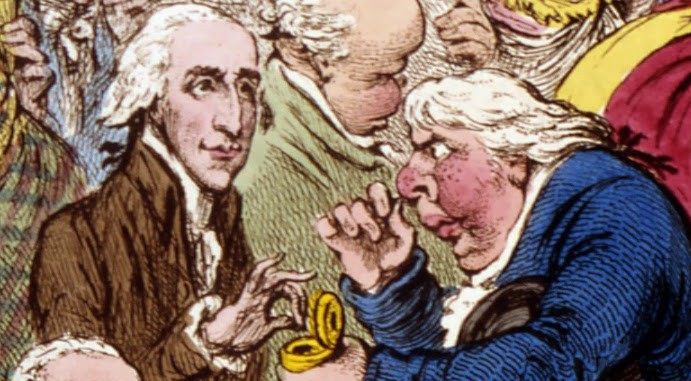
Snuffers drawingOne of the perks of writing a novel set in the 18th century is that tobacconists around the world will send you free boxes of snuff. Just because I’m working exclusively in quill and ink, everyone assumes I indulge in the Age of Enlightenment craze for snorting ground-up tobacco. Maybe my name got on a list when I ordered the powdered wig (it’s being made from my old beard, which I of course saved).

I can claim a legitimate interest in snuff because the narrator of my stories, Jonathan Plummer, is a peddler. He sells tins of the stuff, along with needles, scissors, cures for the clap, poems and sermons and news accounts from his own pen, and — out of the depths of his seemingly bottomless basket — certain materials of interest to the discerning adult reader. Snuff was omnipresent in old Newburyport. It was even produced locally: a snuff mill in Byfield, the maker of Pearson’s Red Top Snuff, operated from Colonial times until 1990.

Snuff has a place in personal history as well. When I was a small boy in England, Nanny, my fun-loving paternal grandmother who sang in pubs, would send me around to the newsagent’s shop for a tin of her favorite snuff, which she would occasionally share with me. I don’t remember a nicotine buzz or any particular flavor (even though the powdered tobacco is often mixed with menthol, aniseed, eucalyptus, or various fruits and herbs), just the immediate urge to sneeze. I was told that sneezing was the whole point. And if Nanny said it, I believed it.

So now I have all these snuffs arriving. The first package, from the Swedish company Gotland’s, contained several tins of a special autumn blend known as Höstsnus. It’s a sweet, fruity snuff that reminds me of apples and blackberries. Höstsnus is manufactured on a seasonal schedule that commences in Week 37 (early September) and ends on October 30. You can bet we’ll be handing these out to trick-or-treaters.

An English mixture that intrigued me is Hedges L260 (Mr. Hedges evidently had a life before he met Mr. Benson). “The menthol blast is borderline insane, but incredibly refreshing,” wrote one reviewer. Another customer commended it for its “nice pinchability.” I just had to try some. A pinch every morning turned into a pinch twice a day, and now I dip into the Hedges L260 about once every twenty seconds. It’s that refreshing.

white snuffWilsons of Sharrow sent me a tin of its own minty snuff, a fine white tobacco-free powder you probably don’t want to pack in your airline luggage.

The most interesting item is a canister of something called Angelick Snuff. It appeared in my mailbox one morning, apparently hand delivered, with no hint as to its origin. The purple tin was slightly rusty, its print faded almost to illegibility, but the powder inside smelled heavenly, like lilacs and mother’s milk. When I Googled “Angelick Snuff,” I could find no manufacturer producing it, no vendor distributing it. There was only one reference at all, a newspaper advertisement from the 1700s. “Angelick Snuff,” the ad read —

[t]he most Noble Composition in the World, instantly removing all Manner of Disorder of the Head and Brain, easing the most excruciating Pain in a Moment; taking away all Swimming or Giddiness, proceeding from Vapours, or any other Cause; also Drowsiness, Sleepiness, all other Lethargick Effects; perfectly curing Deafness to Admiration, and all Humours or Soreness in the Eyes, wonderfully strengthening them when weak.

As I read these miraculous claims, I sensed the faint beginnings of a headache. I suffered from several other brain disorders as well — drowsiness, lethargy, and possibly deafness to admiration (I couldn’t be sure; I only knew I hadn’t heard any admiration in a while). What the heck, why not, I thought, as I pried the lid off the Angelick Snuff. I sprinkled a pinch of lavender-tinted powder on the back of my left hand and sniffed hard.

The walls of my study darkened into a roiling ocean. Saltwater blasted my face, and I leaned into a tremendous gale. I was the helmsman of a barkentine — which I somehow knew, without having to consult Wikipedia, was a sailing vessel with a square-rigged foremast and fore-and-aft rigged main, mizzen, and any other masts — and I was guiding her through an Atlantic storm. “Damn ye winds!” I shouted into the heavens. “Ye’ll not defeat me though ye blow and blow! Howl on, winds! Howl on!”

A minute later the winds died down and I was safe and dry in my study again. The headache was gone.

dailypost19jan1739

Pardon my anachronism

Tags

,

Today I had to decide whether a dowager in 1801 would have been more likely to “draw near” or “draw nigh.” It was easy. I mean, really easy. A few years ago, when it was merely somewhat easy, I would have been forced to rely on the little voice inside me that whispered, “Come on, bonehead, only trashy romance novels have characters drawing nigh, usually as they unfrock their comely bosoms.” But today I found my answer by heading straight to Google Ngram Viewer.

Do you ever use this remarkable language tool? I generally get blank stares when I mention it to people. But it’s well worth experimenting with, even if you’re not a writer.

Ngram Viewer is a byproduct of Google’s mass absorption of the world’s published works, more or less from Gutenberg to the present. Billions of words and phrases from millions of books now reside in Google’s chronological database.

An ngram, which sounds like something out of Scientology, is a unit of language — where n is the number of words in the phrase you want to study. Type in your word or phrase, choose the language database you want to search (your options include British, American, and other flavors of English), and specify the time span you’re interested in. Google then looks at all phrases of similar length in all books and journals within your chosen period, and calculates the percentage of phrases that match yours. This is usually a tiny fraction of 1 percent, many zeroes past the decimal point and not illuminating in itself (unless the number happens to be straight zeroes — that tells you a lot). But when many such percentages are graphed over time, as happens in Ngram Viewer, you get a userful snapshot of the term’s frequency in print as it went in and out of fashion.

Ngram Viewer would have helped the Downton Abbey people avoid some verbal gaffes — like “get shafted,” a phrase we are to believe Thomas the footman would have uttered in 1918. Computer says: No. Not before the 1960s.

Get shafted ngram

You can trace several terms at once, as I did with “draw near” and “draw nigh,” to compare their fortunes over time. In publications from 1801, “draw near” was the clear favorite. Just as I suspected.

Draw near ngram

But one question still nagged me: Did I really want to use either of those phrases? They sounded so . . . prissy. I enlisted another cool Ngram Viewer feature: beneath the graph were links to the original publications, arranged by year, showing the context in which each phrase was used. Both terms, including the more popular “draw near,” were most common in fusty devotional texts: A Selection of Hymns from the Best Authors (1796), The Whole Works of the Late Rev. Mr. Ebenezer Erskine (1798), The Scotch Minister’s Assistant (1802). The little voice was right: “draw near” would have had an inch of dust on it even in 1801.

Would you like to know what my dowager did instead of draw nigh or near? She “trotted up the garden path,” of course.

Where to find quills

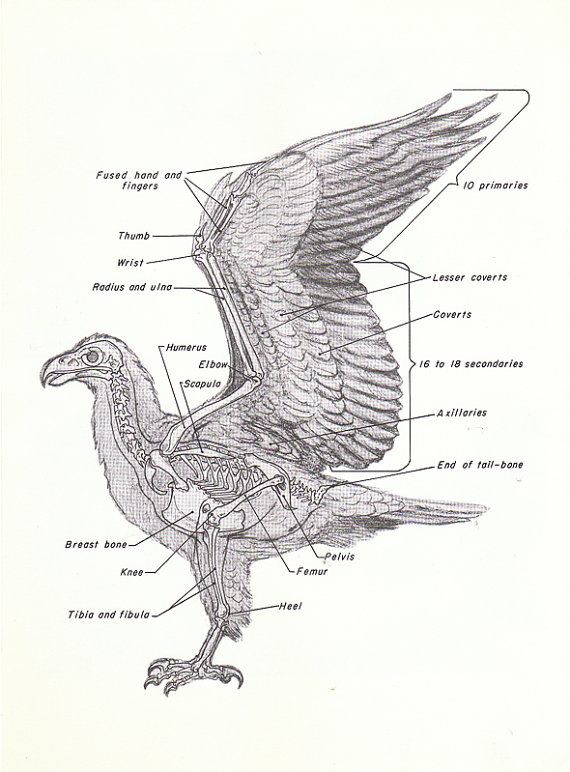
To ensure that His Effing Nibs (the book) contains only 100-percent authentic powdered-wig-style prose, I am writing the entirety of the first draft with a quill pen. I should say quill pens, as each nib lasts only a page or two under my clumsy hand (I’m told my mileage will improve as I develop a lighter touch and a better command of the 18th-Eagle diagramcentury flourishes). For now, I require a steady source of plumage. And the best plumage for writing stories that take place in the Revolutionary and Federalist eras is of course that of the American bald eagle, the national bird. Luckily, there is an eagle sanctuary not a mile from my house. One has only to climb the 150-foot pines on which the birds build their nests, or aeries, to find a lifetime supply of free writing instruments (and to think I used to have to raid the supply closet at Tufts Magazine for that purpose!).

A word to the wise: wear leather gloves, the thicker the better, and make sure the eagle is asleep before setting to work. The second and third primary flight feathers of the left wing are the ones you want (assuming you are right-handed). It is best to wait several days before approaching the same bird again.